

Every material will eventually return to the biosphere, and whether it does so as a resource or as a pollutant is a design choice.
Start with a forest floor.
A leaf falls. Within hours, it crunches under the feet of adorable mammals like deer and raccoons. Tiny invertebrates begin fragmenting it, bacteria colonise its surface. Fungi begins threading into it. Microbes metabolise what remains. In a matter of weeks if not days in some parts of the world, what was once a leaf has been transformed into nutrients that feed the very tree that dropped it. Nothing is lost. Everything is continuously becoming something else, sharing and rearranging. The forest doesn’t have a waste problem because it has decomposers: the patient, invisible architects of renewal that sit at the heart of every healthy natural system.
Now consider the fashion industry. In 2021, The Biomimicry Institute published a report that started from a deceptively simple question: what would fashion look like if it actually operated like a natural ecosystem? We looked at how natural materials cycle, and why. We went back to the first of all principles: the fundamental rules that run our physical world.
What we found is something the industry has been quietly avoiding. It is a truth rooted not in opinion but in the laws of physics.
The Law No Circular Economy Can Escape
The second law of thermodynamics is non-negotiable. Materials trend towards dispersal. Industrial loops leak. No matter how elegantly we design a recycling system, no matter how tightly we imagine our circular loops, the biosphere is always the outermost container. Everything we make is ultimately inside nature, not alongside it.
If materials are going to escape our industrial systems regardless, then the question isn’t how to stop them from leaking — it’s what they become when they do.
In nature, this is entirely solved. What disperses from one organism becomes nutrients for another. The fallen leaf fuels the forest. This works because natural systems are built around three interlocking actors: primary producers, consumers, and decomposers. Producers concentrate energy and matter into useful forms. Consumers extract that value. And decomposers break everything back down into the building blocks that producers need to begin again.
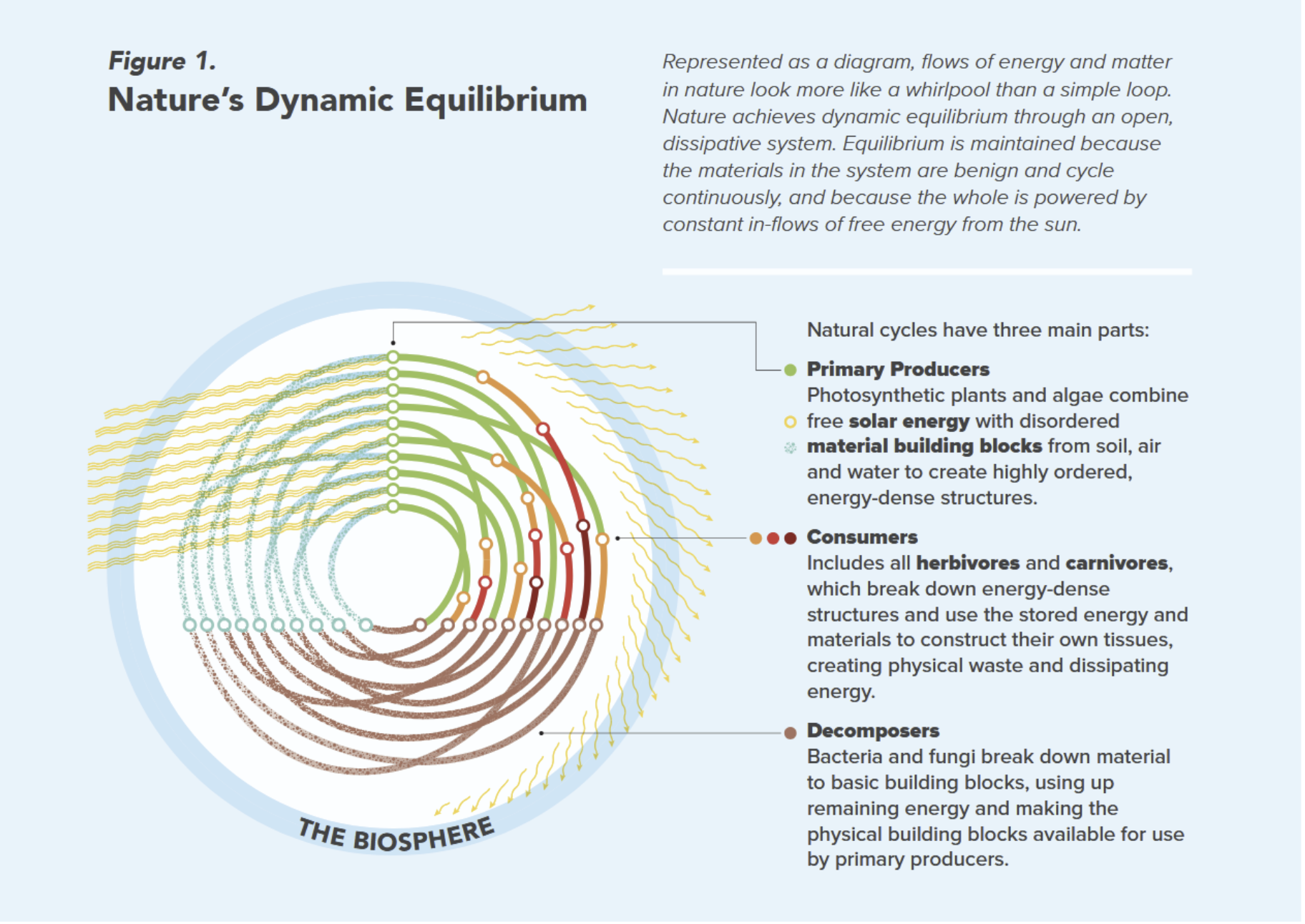
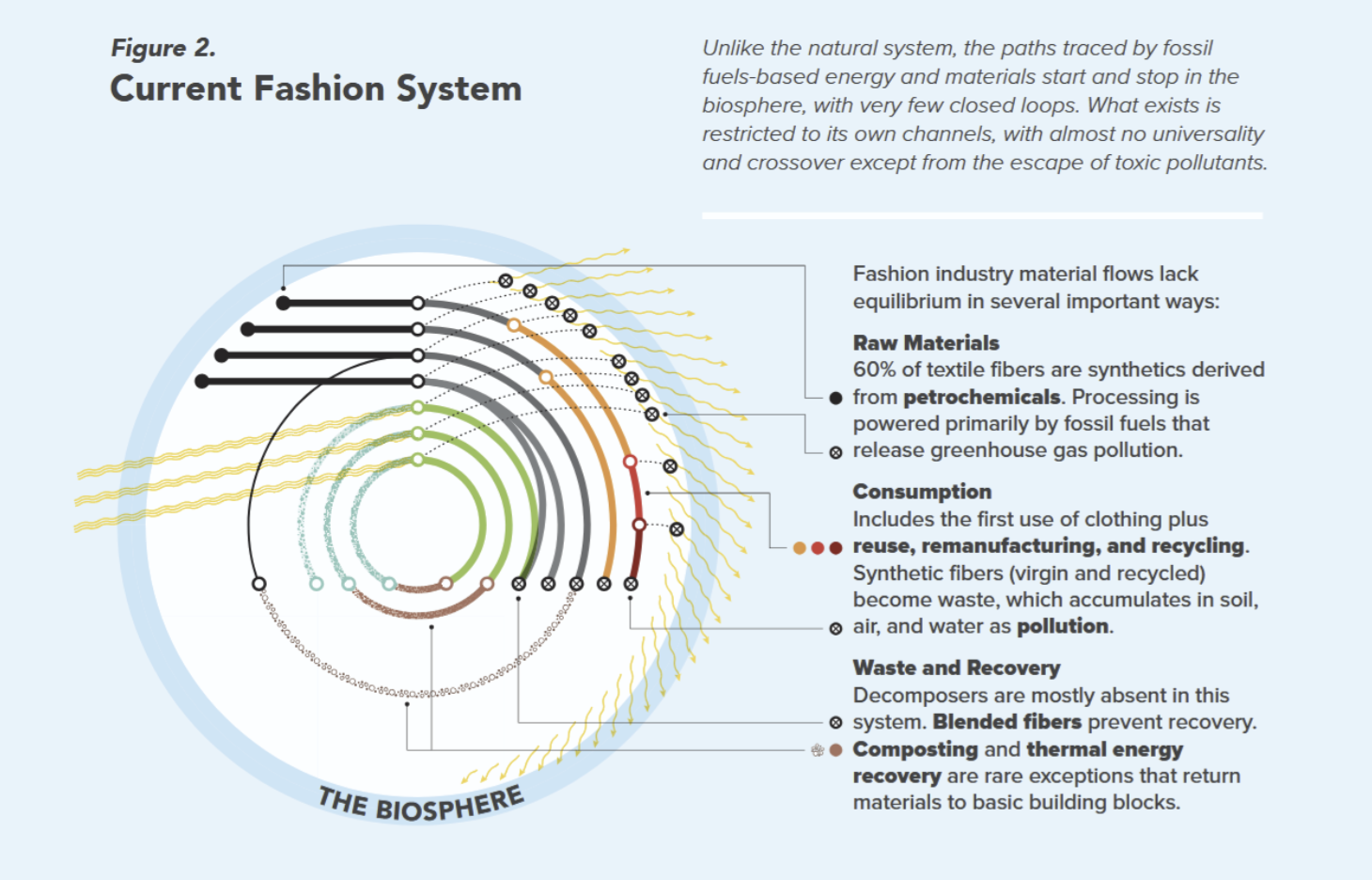
Fashion has built extraordinary infrastructure around the first two. We grow fibres, spin yarn, weave cloth, design garments, and recirculate them through increasingly sophisticated resale and recycling channels. But we have largely forgotten the third actor. We have built a system with no decomposers, and the consequences are everywhere.
When textiles escape our industrial loops, as they inevitably do, there is nothing waiting to receive them. Polyester fibres shed into oceans as microplastics. Blended, dyed, chemically-treated garments pile up on the banks of sacred waterways. The link between decomposition and primary production — the link that makes natural systems endlessly generative — is broken in the systems we have built. Waste becomes pollution; not because we have been careless, but because we have been incomplete.
The Missing Engine
This is the central insight that drives the Nature of Fashion: Design for Transformation initiative, led by The Biomimicry Institute and funded by Laudes Foundation. Decomposition is not a niche concern, a technical footnote, or the last resort after recycling fails. It is the missing engine of true circularity. And without it, every circular economy model we build is solving only part of the problem.
This is not an argument against recycling. Recycling is vital where existing infrastructure is hard-won and must be preserved. But recycling, alone, cannot address a system that exceeds planetary boundaries by design, produces materials that have no safe decomposition pathway, and concentrates its failures in the communities least responsible for creating them. Decomposition begins where recycling reaches its limits, receiving what remains. It is the phase that transforms spent materials back into the building blocks of new life. It is, in nature, how abundance perpetuates itself.
The Nature of Fashion initiative is now in its second phase, working with three pilot partners across three very different contexts to test what it actually looks like to bring decomposition back into the textile industrial system. Each pilot is locally adapted, ecologically grounded, and asks a different version of the same fundamental question: how do we learn to design endings well?
Three Pilots, Three Answers
In the Netherlands, Circle Economy and partners including EV Biotech, BioFashionTech, and TNO are building a system of partnerships that resembles a forest floor at industrial scale. Instead of waiting for a single technology to solve everything, they asked what happens if you link enzymatic hydrolysis, bacterial fermentation, and gasification together — each processing a different fraction of mixed textile waste, each feeding its outputs into the next phase, each performing the role of a different decomposer in a natural ecosystem. The discovery is already significant: these processes can work synergistically. A tangle of unsellable, unsortable mixed textiles that would otherwise be incinerated becomes glucose, biodegradable polymers, and syngas. Waste becomes feedstock. The Netherlands becomes, quietly, a proof of concept for industrial symbiosis at the systems level.
In Germany, the Beneficial Design Institute and partners at the Fraunhofer Institutes are extending this logic further. Polyester-rich textile waste is hydrolysed and fermented into PHB, a biodegradable biopolymer with promising medical applications. And in a process that feels almost improbable, CO2 from the syngas of gasified textile waste is fed to microalgae, which process it via photosynthesis to produce beta-glucan for agriculture and biomaterials. Carbon cycling back into living systems. The Berlin-Brandenburg region is positioned to become a textile bioeconomy hub where discards from one process become the input for another, exactly as nature has always operated.
These two European pilots are pursuing commercial viability, technical innovation, and systems integration. They are essential. And they tell part of the story.
The other part of the story is in Accra.
Where the System Ends Up
Kantamanto Market in Ghana processes around 15 million used garments every week, imported from the UK, the EU, the US, Canada, and China. It is one of the world’s largest secondhand clothing hubs, providing an extraordinary service of keeping garments in use within a broken system built on overproduction. As fashion novelty accelerates and garments are designed to be disposable, the task becomes impossible to complete. What cannot be sold accumulates. And it accumulates in Korle Lagoon — Naa Korle, a sacred waterway behind the market that has absorbed decades of the world’s textile waste.
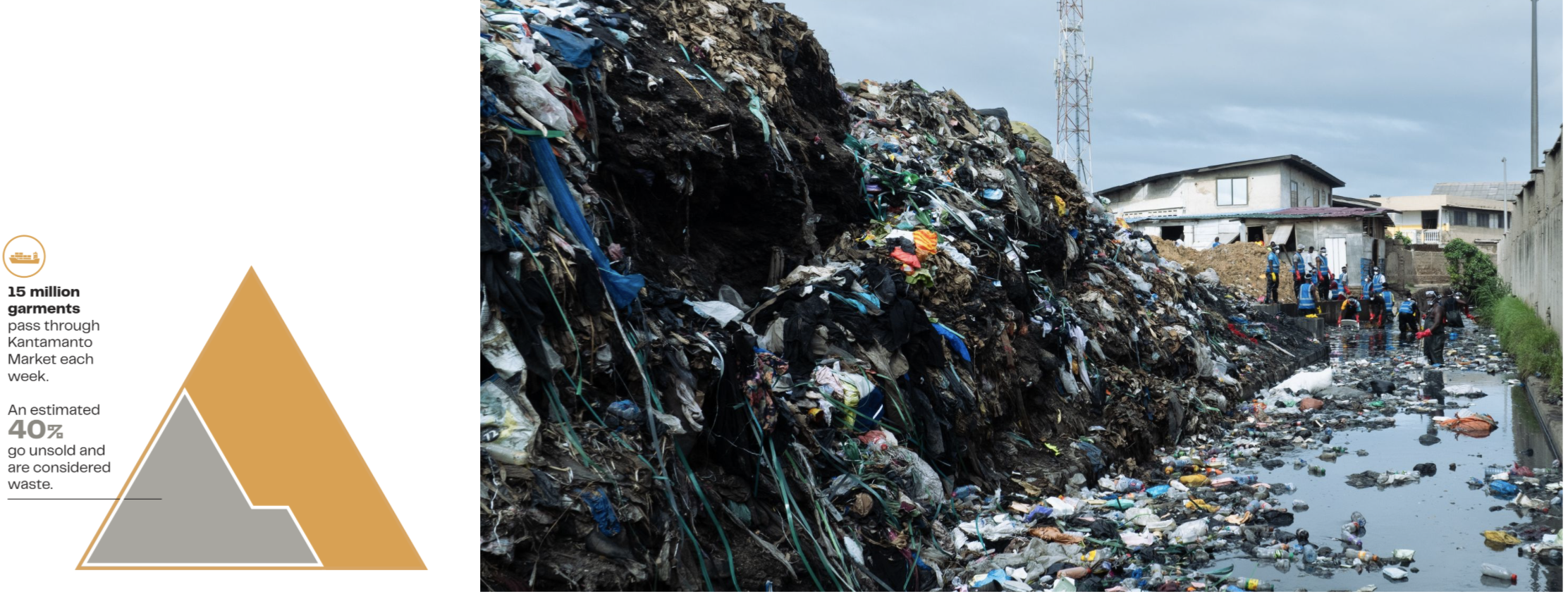
And yet, underneath the ecological devastation, life is innovating. The lagoon’s microbial communities are evolving to metabolise polymers once considered indestructible. Korle is not just a site of crisis. It is an evolution hotspot.
What the Or Foundation has discovered at Korle is something that reframes the entire conversation. The lagoon’s microbial communities are evolving under the evolutionary pressure of extreme synthetic pollution to metabolise polymers once considered indestructible. Korle is not just a site of crisis. It is a Living Lab, the most concentrated ecosystem on earth for synthetic textiles. Developed not in a laboratory, but in direct response to what the fashion industry sent there.
The Or Foundation’s pilot does not seek to out-engineer this. The team seeks to learn from it, support it, and ultimately restore the lagoon and the community surrounding it. Community members are co-investigators. The science being developed through field-deployable DNA analysis tools, bioreactor designs informed by the lagoon’s own microbial logic, is grounded in a principle of democratised knowledge. And the work holds a truth that no amount of industrial biotech can circumvent: the communities at the end of the line are also the communities with the most intimate knowledge of what the system has produced. Justice and ecological intelligence are not separate conversations. They belong together and are inextricably linked.
What This Asks of Us
The Nature of Fashion initiative does not offer a silver bullet. That framing is precisely what we are trying to move beyond. What it offers is a paradigm upgrade: a way of thinking about the fashion industry as nested within natural systems, constrained by the same physical laws, and therefore capable of learning from the same biological genius that has sustained life on earth for billions of years.

This means designing textiles as nutrients from the very beginning, understanding that every material will eventually return to the biosphere, and that whether it does so as a resource or as a pollutant is a design choice. It means investing in decomposition infrastructure alongside recycling infrastructure, understanding that these are complementary, not competing. It means confronting the fact that the places where textile waste accumulates most intensely are not peripheral to this story but in fact central to it.
And it means approaching this work with the humility that nature itself models and accepting that transformation takes time. On the forest floor, decomposition happens not through force but through collaborations: the right organisms, the right environment, the right sequence. 3.8 billion years of evolution have refined those conditions to extraordinary efficiency.
We are at the beginning of understanding how to do the same. The pilots in the Netherlands, Berlin-Brandenburg, and Ghana are showing us that it is possible, and that it is already underway — in laboratories, in living lagoons, and in the communities who have been waiting for the rest of the system to catch up.
In nature, every ending is the beginning of something new…
Everything we make will come back to the earth. The question has always been what it becomes when it does.
Asha Singhal is Director of the Nature of Fashion: Design for Transformation initiative at The Biomimicry Institute. The initiative is funded by Laudes Foundation and works with pilot partners The Or Foundation (Ghana), Circle Economy (Netherlands), and Beneficial Design Institute (Germany). Learn more at biomimicry.org . Case studies from all three pilot partners are published and can be viewed here.